

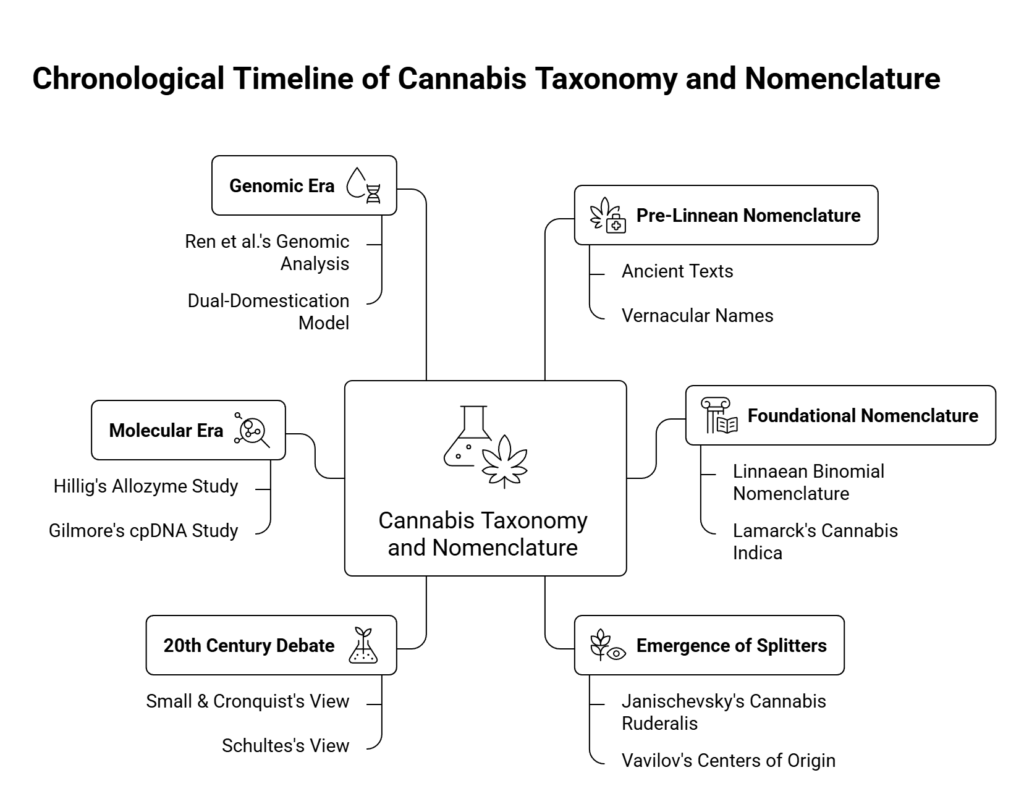
In this guide we will discuss how we reached to a conclusive decision for the Taxonomy of Cannabis we use to describe the Cannabis as a specie. Taxonomy is crucial for discovering and describing species with broad implications for biodiversity, conservation, and scientific understanding today.
WHAT IS TAXONOMY
Taxonomy is a practice of naming, organizing, defining, and classifying living organisms in hierarchy based on their shared characteristics. Think of it like a filing system, without taxonomy we could not share knowledge to distinguish between species which is crucial for studying relationships and evolution of organisms.
Yet, even within this filing system, scientists often debate how detailed the categories should be, leading to the classic distinction between “lumpers” and “splitters.”
Cannabis Taxonomy
Establishing a coherent, dependable, and universally accepted taxonomic framework of Cannabis has been pre-requisite for progress. It clears the confusion and provides a solid foundation.
The classification of cannabis Genus is one of the most debated and prominent issues in modern botany.
The debate for too long has been swinging between a Lumpers view of a single species, and a splitters view of multiple species. This Taxonomic confusion of cannabis arises from the plant’s diverse morphology, its interaction with humans and other causes like legal prohibition of Cannabis which stifled scientific inquiry.
It enables conservation of genetics; guides breeding programs and discloses plants evolutionary history. Taxonomy provides clear definitions for legal and regulatory definitions and agricultural policies for industrial hemp and medical cannabis. The most acknowledged scientific view classifies the cannabis under Single species.
• Kingdome: Plantae
• Order: Rosales
• Family: Cannabaceae
• Genus: Cannabis
• Species: Cannabis Sativa L
Lumpers Vs Splitters
The two different philosophies of classifications, Lumpers and Splitters.
Lumpers prefer broader categories and grouping organisms together if their differences seem minor.
While splitters highlight distinctions and create more narrowly defined groups to capture subtle variations.
CANNABIS NOMENCLATURE
First scientific binomial, the nomenclature for cannabis was established by Carl Linnaeus in 1753. Linnaeus named the plant Cannabis Sativa L.
Thus, starting point for all modern Cannabis nomenclature, is Cannabis Sativa L. Sativa, the specific epithet, Latin word with meaning “sown: or cultivated” highlighted it as the domesticated plant which was used for Fiber and seed in EU.
Pre-Binomial names of Cannabis
This Includes Cannabis mas “Male Hemp” which referred to seed bearing female plants considered more robust. And Cannabis Femina, or Foemina “Female Hemp” for pollen-producing male plants which were considered less useful. Pre-Linnaean botanists mislabeled the plants and created a historical ambiguity.
Chinese Vernacular Names for Cannabis
The traditional Chinese farmers long ago (2700 BCE) observed cannabis dioecious nature correctly, separating male and female plants before the western botanists.
The oldest and most overarching term for cannabis in China was 麻 (Má). 大麻 /Dàmá, the Great hemp or large hemp plants of fiber varieties.
火麻/Huǒmá, fire Hemp used to refer the plants psychoactive properties in traditional Chinese medicine. But the biological terms for female hemp and male help were 雌麻/Cīmá and 雄/Xióngmá respectively.
CHRONOLOGICAL TIMELINE OF CANNABIS TAXONOMY AND
NOMENCLATURE
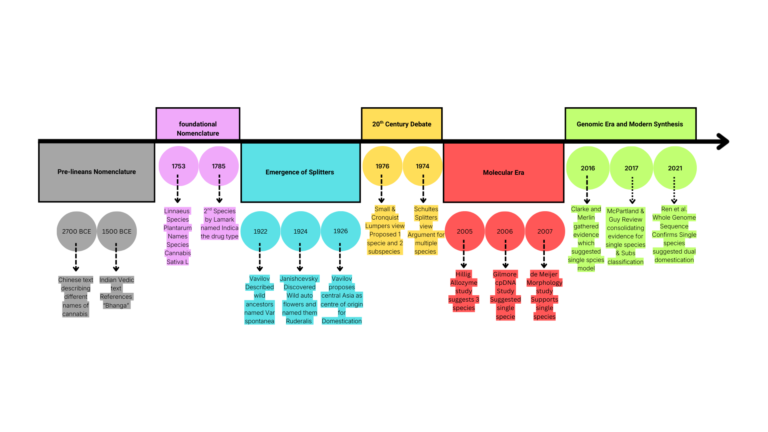
• PRE-Linnean NOMENCLATURE (2700-1500 BCE): Ancient text describing different names of cannabis.
• FOUNDATIONAL NOMENCLATURE OF CANNABIS (1553-1785): Foundational Nomenclature of science contributed by Linnaeus and Lamark
• EMERGENCE OF SPLITTERS (1922-1926): contributions made by the Vavilov and
Janishcevsky suggested more than 1 species.
• 20TH CENTRURY DEBATE (1976-1974): in This period Small & Cronquist Lumper views proposed single species with two subspecies. But Schultes had splitter’s view and
suggested multiple species
• MOLECULAR ERA OF CANNABIS (2005-2007): Hillig Allozyme study suggested 3 species while Gilmore cpDNA and de Meijer Morphological study supported single specie concept.
• GENOMIC ERA AND MODERN SYNTHESIS OF CANNABIS (2016-2021): Clarke & Merlin, McPartland & Guy did not provide newer evidence for single species concepts, rather they put together all the evidence till their time to clear out the confusion. Ren et al Whole genome sequence suggested a unique finding for emergence of Cannabis as single species and providing the origin based on scientific evidence, suggesting East Asia, lowlands as the origin of cannabis plant.
FOUNDATIONAL NOMENCLATURE OF CANNABIS (1553-1785)
Linnaean Binomial Nomenclature (1753)
This reference comes from Species Plantarum, published in 1753 by Carl Linnaeus, the book that laid the foundation of modern botanical naming.
This is where the name Cannabis sativa L officially begins. Linnaeus first introduces the plant simply as Cannabis, sativa. Before standardized binomials existed, plants were described using diagnostic phrases.
In this case, Cannabis foliis digitatis, meaning cannabis with hand-shaped leaves.
We see Linnaeus citing earlier botanical works in his book Species Plantarum. He was organizing centuries of fragmented descriptions into one system.
What’s interesting is how sex was described at the time. Earlier the Seed-bearing plants were labeled ‘male’, and pollen-producing plants were labeled ‘female’. This was symbolic, not biological. But usefulness dictated naming, not reproduction.
And when Linnaeus writes ‘Habitat in India’, it wasn’t based on direct observation. It was an assumption drawn from earlier accounts. The actual specimen he studied came from European hemp.
Lamarck’s Cannabis indica (1785)
In the late 18th century, the French botanist Jean-Baptiste Lamarck documented Cannabis Indica. He described a plant he called Cannabis indica, originally hemp from India, clearly separating it from the European hemp described earlier by Linnaeus. This plant was different. Shorter in stature. Herbaceous, grooved, and heavily branched.
Lamark description for Cannabis Indica was, leaves dark green on top, pale underneath, fully serrated like a saw. Upper leaves simple and alternate, lower ones opposite. Long, narrow, sharp leaflets.
Lamarck also noted that male and female flowers occur on separate plants, and this plant was described as perennial.
Most importantly, he documented its use. From this Indian cannabis, a resin or fume was collected known locally as Tcharras, or charas, used for its intoxicating effects. This was the first formal recognition of psychoactive cannabis in Western botanical literature.
EMERGENCE OF SPLITTERS (1922-1926)
The Wild Species from Central Asia D.E. Janischevsky (1924)
In the early 20th century, the Russian botanist Dmitrij Janischevsky documented wild cannabis populations growing across the Volga River Basin and southeastern Russia, in areas that today include parts of Ukraine and western Russia.
These plants were not escapees from farms. They grew as true weeds in disturbed environments, roadsides, dump sites, and animal resting grounds. Janischevsky argued that they represented a native, wild form of cannabis, which he formally described as Cannabis ruderalis.
What set these plants apart was their Physicality. They were small in stature, rarely exceeding half a meter in height, and heavily branched from the base, forming compact, bushy plants, unlike the tall, single-stemmed structure of cultivated hemp from Europe.
Most importantly, these plants flowered based on age, not day length (Photo-independent Cannabis plants). They entered bloom after roughly five to seven weeks, regardless of photoperiod, a trait now known as obligate auto-flowering, later linked to the Autoflower1 gene.
The seeds Cannabis Ruderalis also had distinct features. They were smaller than those of cultivated cannabis and carried a prominent oily appendage, known as an elaiosome. This structure attracted ants, allowing the seeds to be dispersed through a process called myrmecochory.
The seeds were further protected by a tightly adhering, marbled floral envelope, providing camouflage, and they possessed a well-developed abscission layer, allowing them to shatter and disperse easily at maturity. Germination was slow and uneven, a classic survival strategy in wild plant populations.
Ecologically, Janischevsky recognized these plants as true ruderals, adapted to survive harsh climates, short growing seasons, and unpredictable conditions.
Based on this unique combination of morphology, life cycle, seed structure, and ecology, Janischevsky concluded that these populations represented a distinct species: Cannabis ruderalis.
Vavilov’s Centers of Origin (1920s-1930s)
While studying the origins of cultivated plants, the Russian geneticist Nikolai Vavilov placed Cannabis sativa firmly within his Central Asian Center of Origin.
This region included northwestern India which is now modern-day Pakistan, Afghanistan, Soviet Central Asia such as Tajikistan and Uzbekistan, and the western Tian-Shan range. His reasoning was straightforward that this region showed the highest genetic diversity of cannabis anywhere in the world. And in Vavilov’s framework, diversity points to origin.
He wrote that hemp in Central Asia was represented by a whole series of highly diverse races, making the conclusion that this region was one of the most important and independent centers of agricultural origin.
Vavilov made a critical distinction between cultivated hemp and the wild, weedy/spontaneous forms growing alongside human settlements. In 1922, he described this wild plant as Cannabis sativa var. spontanea.
These plants carried small seeds with a strong abscission layer, shattered easily at maturity, germinated slowly and unevenly, and thrived in disturbed soils, traits consistent with truly wild species rather than an escape from cultivation.
Vavilov argued that this weedy hemp, which was Photoperiod in nature, from the Kunar-Chitral River region represented the genuine ancestral population from which domesticated drug type cannabis emerged.
During his expeditions to Afghanistan, Vavilov also identified a distinctly different form of cannabis. He described it as Cannabis indica as Afghanica, a short, densely branched plant with very broad leaflets, well adapted to arid environments.
This form was not grown for fiber or seed. It was cultivated specifically for resin production for drug use.
Vavilov recognized it as a separate landrace within the Central Asian center, representing a different domestication pathway. This population forms the foundation of what we now call broad leaf Afghan or indica-type drug cannabis.
Vavilov’s work outlined a clear model of cannabis domestication.
A wild, weedy ancestor followed nomadic human populations, growing in nutrient-rich campsites. From this shared gene pool, humans selected in different directions. In some regions, they favored tall plants with long fibers and non-shattering seeds. In others, they selected compact plants rich in glandular resin.
According to Vavilov, fiber hemp in Europe and drug-type cannabis in Central and South Asia were likely domesticated independently from different populations of the same wild ancestor, shaped by geography, climate, and human use.
20TH CENTURY DEBATE OF CANNABIS SPECIES
Ernest Small and Arthur Cronquist’s View (1976)
In 1976, botanists Ernest Small and Arthur Cronquist published A Practical and Natural Taxonomy for Cannabis.
Stating that all forms of cannabis belong to a single species which is Cannabis sativa L. This work was a response to the growing ‘splitter’ views, which proposed multiple species such as Cannabis indica and Cannabis ruderalis. Small and Cronquist rejected this view, arguing that the observed diversity in cannabis does not meet the biological threshold for multiple species.
Their first and strongest point was interbreeding. All cannabis populations, regardless of height, leaf shape, or chemical profile can freely cross and produce fully fertile offspring. Under classical biological species concepts, this alone supports a single species.
Second, they showed that cannabis traits vary continuously. Characteristics are often used to divide the genus, plant stature, leaflet width, branching pattern, or resin production, overlapping broadly across populations. There are no clear morphological boundaries that would justify separate species.
Third, they challenged the use of cannabinoid content as a taxonomic marker. Their research demonstrated that THC and CBD dominance is controlled by a simple genetic polymorphism.
Through hybridization, chemotypes can shift rapidly, making chemical profiles an unreliable basis for species separation. Rather than splitting cannabis into multiple species, Small and Cronquist proposed a practical infraspecific system within a single species.
They divided Cannabis sativa into two subspecies, based primarily on intoxicating potential or Cannabinoid profile. The first is Cannabis sativa subsp. sativa. This group includes hemp cultivated for fiber and seed. Its defining feature is a non-intoxicating chemical profile, with a THC-to-CBD ratio below one.
These plants are often tall and loosely branched, but morphology was considered secondary to chemistry. The second is Cannabis sativa subsp. indica. This subspecies includes all drug-type cannabis. Its defining characteristic is intoxication, with higher percentage of THC over CBD. Morphology may
range from narrow-leafed Asian and African drug types to broad-leafed Afghan populations.
Importantly, Small and Cronquist grouped all psychoactive or drug type cannabis into this single subspecies, explicitly rejecting narrower interpretations that restricted indica only to Afghan form. Their system aimed to have taxonomy that is usable for agriculture, research, and law enforcement.
Small and Cronquist argued that cannabis is one highly variable species, shaped by human selection rather than divided by natural species boundaries.
THE MOLECULAR ERA OF CANNABIS TAXANOMY 2005-2007
Hillig, Alozyme study (2005)
Botanist Karl Hillig introduced a genetic challenge to the single-species model of cannabis taxonomy. Using large-scale allozyme analysis, an enzyme-based genetic method. Hillig examined cannabis accessions from across Europe, Central Asia, South Asia, East Asia, and Africa.
His results showed that cannabis diversity was not random or continuous but structured into distinct genetic groups. The principal components analysis revealed two primary gene pools.
The first was the Cannabis sativa gene pool. This group included traditional European and Central Asian fiber and seed hemp, along with weedy ruderal populations from Eastern Europe.
Genetically, these plants clustered together and represented the classic hemp lineage described by Linnaeus. The second was the Cannabis indica gene pool. This group was far more diverse. It included narrow-leaflet drug types from South Asia, Africa, and Latin America, wide-leaflet drug types fromAfghanistan and Pakistan, feral populations from India and Nepal, and even fiber and seed
landraces from East Asia, including China, Korea, and Japan.
Despite their wide morphological differences, all these plants shared a common genetic foundation, placing them firmly within a single, expanded indica lineage.
Hillig also found preliminary evidence for a third gene pool corresponding to Janischevsky’s Cannabis ruderalis and Vavilov’s Var. Spontanea. These were wild or weedy populations from Central Asia. While the sample size was limited, the genetic signal suggested these plants may represent an evolutionary background.
Based on these findings, Hillig proposed a three-species model for the genus Cannabis. In this framework, Cannabis sativa represents the European and Central Asian hemp gene pool.
Cannabis indica encompasses all Asian drug types, both narrow and wide-leaflet forms, as well as East Asian fiber hemp. Cannabis ruderalis represents the wild, ruderal populations of Central Asia. Within Cannabis indica, Hillig further recognized infraspecific divisions, including narrow-leaflet drug types and wide-leaflet Afghan forms.
This model directly challenged the monotypic view of Small and Cronquist. Hillig argued that the genetic division between the sativa and indica gene pools was too deep to ignore and that treating cannabis as a single undivided species failed to reflect its evolutionary history.
At the same time, his data rejected narrower interpretations of indica. Both Lamarck’s Indian drug plants and the Afghan hashish types belonged to the same genetic lineage. Hillig’s work repositioned cannabis taxonomy around population genetics, offering a framework that aligned morphology, chemistry, geography, and evolution into a unified model.
Gilmore cpDNA Study of Cannabis species
Gilmore approached the cannabis taxonomy debate from a different genetic angle.
Their study analyzed the chloroplast DNA of 31 cannabis accessions from the Drug seizures in Australia, representing plants commonly labeled as Cannabis sativa, Cannabis indica, and Cannabis ruderalis. Several regions of the chloroplast genome were sequenced and compared.
Across all samples, the chloroplast genome was found to be highly conserved. No sequence variation was detected between accessions, morphology, or proposed species designation. Chloroplast DNA is inherited maternally and evolves slowly. It is widely used to detect deep evolutionary splits between species. If cannabis consisted of multiple species, clear differences would be expected in the chloroplast genome. Instead, Gilmore et al. found none. This strongly indicates a shared maternal lineage and a very recent divergence, supporting the interpretation that all forms of cannabis belong to a single species.
At the same time, the study developed 21 new nuclear microsatellite markers tools designed to detect variation within a species. These markers did reveal genetic differences among individuals and populations.
This directly contrasts with earlier genetic studies based on allozymes, such as Hillig’s work, which identified distinct gene pools and argued for multiple species.
Gilmore and colleagues noted that allozymes can reflect adaptive divergence under selection pressure, whereas chloroplast DNA reflects long-term evolutionary history. In this context, the lack of chloroplast divergence outweighs evidence from adaptive markers when defining species boundaries.
The study concludes morphological and chemical diversity seen in cannabis sativa. L leaf shape, plant size, and cannabinoid profile do not represent deep speciation.
Limitation of Gilmore et al Study
One major limitation of the Gilmore et al. 2007 study lies not in the genetics—but in the samples themselves.
All plant material used in the study came from cannabis seized by the Australian Federal Police. The original geographic origin of these samples was unknown. This creates a significant genetic bottleneck.
Seized drug material is most likely derived from a small number of modern, commercially propagated, high-THC cultivars often closely related, hybridized, or clonally maintained. Such material represents only a narrow slice of cannabis diversity.
Critically, the study did not include true wild populations of Cannabis ruderalis from Central Asia, authentic landrace drug types from Afghanistan or the Hindu Kush, African NLD landraces, or traditional fiber hemp from Europe and East Asia. The study demonstrated genetic uniformity within a restricted pool, not across global cannabis diversity.
This contrasts with broader studies, such as Hillig’s work and later genomic surveys, which intentionally sampled wild, feral, and landrace populations from known origins and detected clear genetic structure and regional lineages.
GENOMIC ERA AND MODERN CONCENSUS
THE REN ET AL. (2021) STUDY, LARGE-SCALE GENOMIC ANALYSIS
Ren et al. (2021) provides the strongest genomic evidence so far that cannabis originated in low latitude regions, underwent multiple domestication pathways, and remains best understood as a single species shaped by human selection rather than deep evolutionary separation.
Recent genomic research has significantly reshaped our understanding of cannabis origins and domestication. In 2021, Ren and his colleagues published the largest genome-wide analysis of Cannabis sativa to date. Their findings challenged lots of assumptions, including the idea of cannabis originated in Central Asia.
The study identified the most ancient lineage of cannabis as Haplogroup L, a low-latitude genetic group. This basal lineage is associated with accessions from regions near the equator, including China, India, Pakistan, and parts of Africa.
This indicates that the common ancestor of all modern cannabis first evolved in low-latitude environments and only later adapted to higher latitudes, such as Central Asia. This directly contradicts earlier models that placed the primary center of origin in the Hindu Kush or Central Asia most probably the Vavilov’s work.
Ren et al. also proposed a revised domestication model, often referred to as a dual-domestication framework.
According to this model, the extinct wild ancestor of cannabis was a hemp-type plant, characterized by low THC and higher CBD content. Early humans first domesticated cannabis for fiber and seed in East Asia, giving rise to what we recognize as hemp.
Later, a separate domestication event selected for psychoactive resin production. This involved mutations in the THCA gene, allowing for high THC synthesis. These selections produced the drug type cannabis we now associate with traditional hash and resin cultures.
Importantly, this means drug-type cannabis is not ancestral or wild, it is a specialized form created through human selection, but the evolutionary pathway involved mutation of a certain gene which facilitated the high THC production.
The study also confirmed that the major chemical difference between hemp and drug cannabis is controlled by a relatively small genomic region involving the THCAS and CBDAS genes.
This explains why fiber and drug traits can be rapidly crossed in breeding programs. From a taxonomic perspective, Ren et al. found clear genetic clustering but low overall divergence. They identified four broad genetic groups: basal low-latitude lineages, domesticated hemp, wild or feral high-latitude populations, and domesticated drug types. Rather than supporting multiple distinct species, the data describe Cannabis sativa as a poorly differentiated species complex, one species with multiple lineages that diverged recently and continue to interbreed freely.
CONSENSUS OF EVOLUTION AND ETHNOBOTANY OF CANNABIS SATIVA. L
Clarke & Merlin (2016)
In this framework, cannabis diversity is best understood not as separate species, but as human shaped lineages within one adaptable and genetically unified species.
Rather than splitting cannabis into multiple species, Clarke & Merlin reconcile decades of debate by using a formal subspecies classification. This bridges the gap between lumpers and splitters by lowering the taxonomic rank of previously proposed species.
They recognize three subspecies within Cannabis sativa. First, Cannabis sativa subsp. sativa, the fiber and seed hemp lineage originally described by Linnaeus.
Second, Cannabis sativa subsp. indica, broadly defined to include all psychoactive drug types both narrow-leaflet and wide-leaflet forms.
Third, Cannabis sativa subsp. ruderalis, the auto-flowering wild or weedy lineage from Central Asia, representing the ancestral gene pool from which cultivated forms were derived.
A central argument supporting this model is interfertility. All forms of cannabis can freely interbreed and produce fertile offspring, meeting a core biological criterion for a single species. The authors also criticize the use of morphology for species separation. Traits such as plant height, branching, and leaflet width are highly plastic, shaped by environment and cultivation, and form continuous gradients rather than discrete boundaries.
Instead of multiple isolated wild ancestors, this synthesis proposes a single, polytypic ancestral population. From this shared genetic base, human’s different traits in different regions, fiber and seed in some areas, resin production in others, resulting in the diversity we see today.
In this framework, cannabis diversity is best understood not as separate species, but as human shaped lineages within one adaptable and genetically unified species.
McPartland & Guy (2017)
Together, these works did the critical job of cleaning house. They unified a century of conflicting literature into a single, practical, evidence-based system. The debate shifted away from arguing over species counts and toward understanding how distinct subgroups evolved within one highly
flexible species, a framework later reinforced by genomic data from Ren et al. (2021).
They also address one of the biggest sources of confusion in cannabis science. Cannabis indica is used in the broad sense following Small and Cronquist to include all drug cultivars. This rejects the narrow definition that limits indica only to Afghan wide-leaflet types, a distinction that caused more
problems than it solved.
Chemotaxonomy is treated with caution. While THC/CBD ratios are useful for regulation and practical classification, the authors point out that this difference is controlled by a simple genetic switch.
On ruderalis, their position is precise. Its auto-flowering trait is genetically fixed and tied to a specific ecological niche, which justifies subspecies status. But because it freely interbreeds with other cannabis types, it does not qualify as a separate species.
The broader narrative is co-evolutionary. Cannabis begins as a human camp follower, ruderal populations thriving in disturbed ground. From that shared ancestral pool, humans shaped the plant along two main domestication paths: fiber and seed production in the west, and resin production in the east.